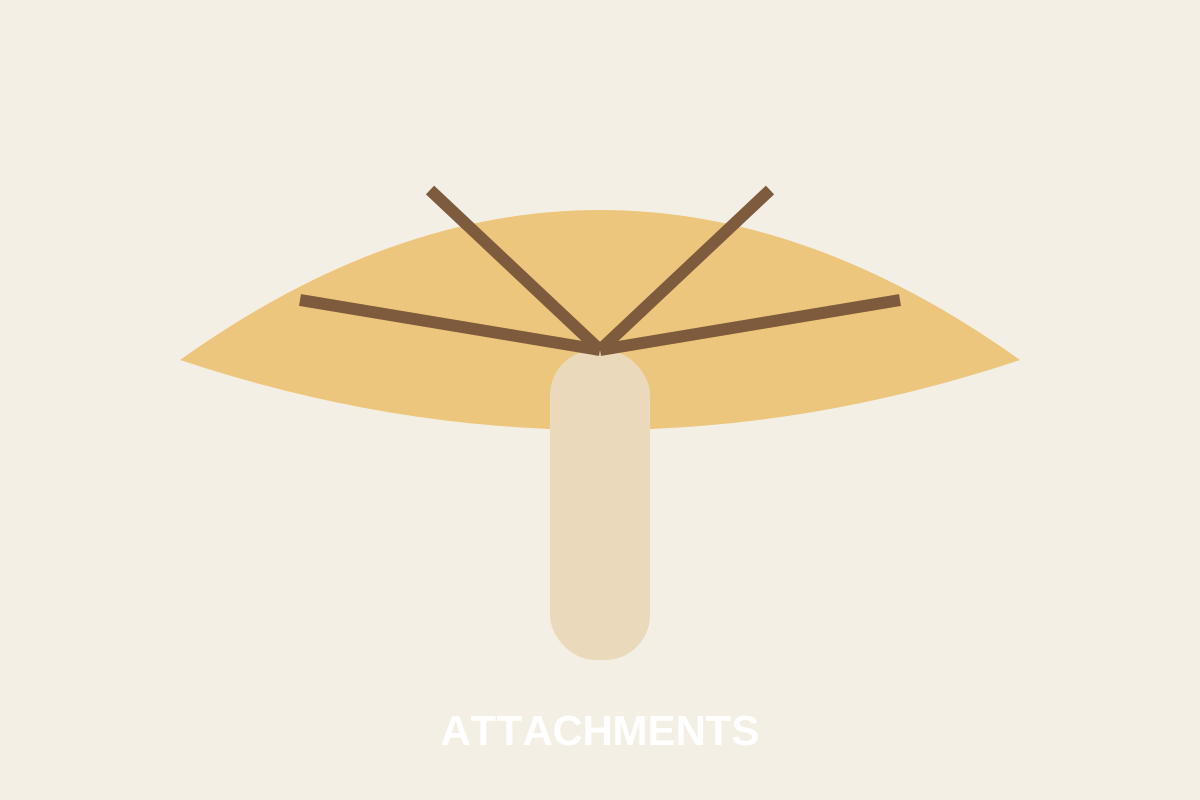
What Does Adnexed Mean? is a long-form educational field guide. It supports careful observation but cannot determine whether a wild mushroom is safe to eat.
Essential definition
what does adnexed mean? is part of the descriptive vocabulary of mycology. Adnexed most often describes gills that reach the stipe but contact it only narrowly. It describes a relationship between structures, not edibility, toxicity, rarity, or evolutionary importance. A sound account records the complete fruiting body and does not treat one character as decisive.
Gill attachment is examined on the underside of an intact cap where lamellae approach the stipe. Adnate gills meet the stipe broadly, adnexed gills meet it narrowly, free gills stop before reaching it, and decurrent gills continue down the stipe. Sinuate or emarginate gills narrow or form a notch before attachment. Real specimens often fall between diagrammed categories.
Mushroom characters can change as a fruiting body expands, dries, becomes saturated, is damaged, or ages. A gill that appears attached when young may pull away later. The cap may flatten enough to alter the visible angle of attachment. Observers should record maturity, condition, and variation among several specimens when collection rules allow.
A complete observation includes cap shape and surface, gill color and spacing, gill edges, attachment, stipe position and texture, base shape, veil remnants, odor, bruising, exudates, substrate, nearby plants, season, and spore deposit color. Microscopic evidence may also be needed. Identification is strongest when independent characters agree.
Why this feature matters
Gills are one form of hymenophore, the structure that carries the spore-producing hymenium. Boletes commonly have pores, tooth fungi have spines, chanterelles have blunt ridges, and many fungi have smooth, folded, enclosed, or otherwise specialized fertile surfaces. Recognizing true gills prevents an early classification error.
True gills are thin plates radiating from near the stipe toward the cap margin. Shorter gills called lamellulae may begin at the margin and end before reaching the stipe. Useful observations include whether gills are crowded or distant, broad or narrow, forked or unbranched, brittle or flexible, and whether they stain or change color.
Spore deposit color can narrow possibilities but is never a complete identification. A print may be white, cream, pink, brown, rusty, purple-brown, black, or another shade. Lighting, paper color, deposit thickness, moisture, and mixed collections can change interpretation. Some groups require microscopic examination rather than deposit color alone.
Microscopy may reveal spore dimensions, shape, ornamentation, germ pores, amyloid reactions, basidia, cystidia, clamp connections, and tissue arrangement. These features can separate species that look nearly identical in the field. Measurements should include multiple mature structures and clearly state preparation methods.
How to observe it
Habitat is part of the specimen. A fungus may grow on wood, litter, soil, grass, dung, moss, living trees, buried debris, or another fungus. Some are mycorrhizal, some saprotrophic, and some parasitic. The apparent ground substrate may conceal roots or wood, so the immediate setting should be documented carefully.
Photographs should show the undisturbed fruiting body, cap surface, full side profile, underside, entire stipe, and untrimmed base. A scale and neutral lighting improve usefulness. A lengthwise section can reveal internal color, chambers, pith, staining, latex, and attachment, but intact features should be documented first.
Taxonomic names and genus concepts change as DNA evidence revises classification. Older field guides can remain useful for morphology, yet names may be outdated or applied differently in another region. Current regional keys, curated collections, and expert review are more dependable than isolated image matches.
An identification feature is useful only within its limits. Adnexed attachment occurs in unrelated groups, and one species can show adnexed, nearly adnate, sinuate, or seceding appearances among specimens. The term helps describe a mushroom; it does not establish a species on its own.
| Attachment | Description |
|---|---|
| Free | Stops before the stipe |
| Adnexed | Narrowly attached |
| Adnate | Broadly attached |
| Sinuate | Notched near the stipe |
| Decurrent | Runs down the stipe |
Changes with age
Mushroom consumption decisions require a higher standard than casual observation. Never infer edibility from gill attachment, cap color, animal feeding, folklore, cooking, or resemblance to a photograph. Some dangerous species resemble edible species, and some toxins are not destroyed by cooking.
A repeatable workflow begins with location and habitat, then documents the intact fruiting body, underside, stipe base, veil structures, color changes, odor, and substrate. The observer may then obtain a spore print, consult regional keys, compare authoritative descriptions, and use microscopy or expert review.
Common errors include removing the stipe base, photographing only the cap, mixing species in one spore print, treating an app as a final determination, using a guide from another continent, and assuming one familiar-looking character proves identity.
The central lesson of what does adnexed mean? is disciplined description. Adnexed is a precise but sometimes subjective term for narrow gill attachment. It gains value when combined with anatomy, development, ecology, spores, microscopy, regional references, and honest uncertainty.
Environmental variation
what does adnexed mean? is part of the descriptive vocabulary of mycology. Adnexed most often describes gills that reach the stipe but contact it only narrowly. It describes a relationship between structures, not edibility, toxicity, rarity, or evolutionary importance. A sound account records the complete fruiting body and does not treat one character as decisive.
Gill attachment is examined on the underside of an intact cap where lamellae approach the stipe. Adnate gills meet the stipe broadly, adnexed gills meet it narrowly, free gills stop before reaching it, and decurrent gills continue down the stipe. Sinuate or emarginate gills narrow or form a notch before attachment. Real specimens often fall between diagrammed categories.
Mushroom characters can change as a fruiting body expands, dries, becomes saturated, is damaged, or ages. A gill that appears attached when young may pull away later. The cap may flatten enough to alter the visible angle of attachment. Observers should record maturity, condition, and variation among several specimens when collection rules allow.
A complete observation includes cap shape and surface, gill color and spacing, gill edges, attachment, stipe position and texture, base shape, veil remnants, odor, bruising, exudates, substrate, nearby plants, season, and spore deposit color. Microscopic evidence may also be needed. Identification is strongest when independent characters agree.
Related terminology
Gills are one form of hymenophore, the structure that carries the spore-producing hymenium. Boletes commonly have pores, tooth fungi have spines, chanterelles have blunt ridges, and many fungi have smooth, folded, enclosed, or otherwise specialized fertile surfaces. Recognizing true gills prevents an early classification error.
True gills are thin plates radiating from near the stipe toward the cap margin. Shorter gills called lamellulae may begin at the margin and end before reaching the stipe. Useful observations include whether gills are crowded or distant, broad or narrow, forked or unbranched, brittle or flexible, and whether they stain or change color.
Spore deposit color can narrow possibilities but is never a complete identification. A print may be white, cream, pink, brown, rusty, purple-brown, black, or another shade. Lighting, paper color, deposit thickness, moisture, and mixed collections can change interpretation. Some groups require microscopic examination rather than deposit color alone.
Microscopy may reveal spore dimensions, shape, ornamentation, germ pores, amyloid reactions, basidia, cystidia, clamp connections, and tissue arrangement. These features can separate species that look nearly identical in the field. Measurements should include multiple mature structures and clearly state preparation methods.
Macroscopic anatomy
Habitat is part of the specimen. A fungus may grow on wood, litter, soil, grass, dung, moss, living trees, buried debris, or another fungus. Some are mycorrhizal, some saprotrophic, and some parasitic. The apparent ground substrate may conceal roots or wood, so the immediate setting should be documented carefully.
Photographs should show the undisturbed fruiting body, cap surface, full side profile, underside, entire stipe, and untrimmed base. A scale and neutral lighting improve usefulness. A lengthwise section can reveal internal color, chambers, pith, staining, latex, and attachment, but intact features should be documented first.
Taxonomic names and genus concepts change as DNA evidence revises classification. Older field guides can remain useful for morphology, yet names may be outdated or applied differently in another region. Current regional keys, curated collections, and expert review are more dependable than isolated image matches.
An identification feature is useful only within its limits. Adnexed attachment occurs in unrelated groups, and one species can show adnexed, nearly adnate, sinuate, or seceding appearances among specimens. The term helps describe a mushroom; it does not establish a species on its own.
| Attachment | Description |
|---|---|
| Free | Stops before the stipe |
| Adnexed | Narrowly attached |
| Adnate | Broadly attached |
| Sinuate | Notched near the stipe |
| Decurrent | Runs down the stipe |
Microscopic evidence
Mushroom consumption decisions require a higher standard than casual observation. Never infer edibility from gill attachment, cap color, animal feeding, folklore, cooking, or resemblance to a photograph. Some dangerous species resemble edible species, and some toxins are not destroyed by cooking.
A repeatable workflow begins with location and habitat, then documents the intact fruiting body, underside, stipe base, veil structures, color changes, odor, and substrate. The observer may then obtain a spore print, consult regional keys, compare authoritative descriptions, and use microscopy or expert review.
Common errors include removing the stipe base, photographing only the cap, mixing species in one spore print, treating an app as a final determination, using a guide from another continent, and assuming one familiar-looking character proves identity.
The central lesson of what does adnexed mean? is disciplined description. Adnexed is a precise but sometimes subjective term for narrow gill attachment. It gains value when combined with anatomy, development, ecology, spores, microscopy, regional references, and honest uncertainty.
Field documentation
what does adnexed mean? is part of the descriptive vocabulary of mycology. Adnexed most often describes gills that reach the stipe but contact it only narrowly. It describes a relationship between structures, not edibility, toxicity, rarity, or evolutionary importance. A sound account records the complete fruiting body and does not treat one character as decisive.
Gill attachment is examined on the underside of an intact cap where lamellae approach the stipe. Adnate gills meet the stipe broadly, adnexed gills meet it narrowly, free gills stop before reaching it, and decurrent gills continue down the stipe. Sinuate or emarginate gills narrow or form a notch before attachment. Real specimens often fall between diagrammed categories.
Mushroom characters can change as a fruiting body expands, dries, becomes saturated, is damaged, or ages. A gill that appears attached when young may pull away later. The cap may flatten enough to alter the visible angle of attachment. Observers should record maturity, condition, and variation among several specimens when collection rules allow.
A complete observation includes cap shape and surface, gill color and spacing, gill edges, attachment, stipe position and texture, base shape, veil remnants, odor, bruising, exudates, substrate, nearby plants, season, and spore deposit color. Microscopic evidence may also be needed. Identification is strongest when independent characters agree.
Taxonomic use
Gills are one form of hymenophore, the structure that carries the spore-producing hymenium. Boletes commonly have pores, tooth fungi have spines, chanterelles have blunt ridges, and many fungi have smooth, folded, enclosed, or otherwise specialized fertile surfaces. Recognizing true gills prevents an early classification error.
True gills are thin plates radiating from near the stipe toward the cap margin. Shorter gills called lamellulae may begin at the margin and end before reaching the stipe. Useful observations include whether gills are crowded or distant, broad or narrow, forked or unbranched, brittle or flexible, and whether they stain or change color.
Spore deposit color can narrow possibilities but is never a complete identification. A print may be white, cream, pink, brown, rusty, purple-brown, black, or another shade. Lighting, paper color, deposit thickness, moisture, and mixed collections can change interpretation. Some groups require microscopic examination rather than deposit color alone.
Microscopy may reveal spore dimensions, shape, ornamentation, germ pores, amyloid reactions, basidia, cystidia, clamp connections, and tissue arrangement. These features can separate species that look nearly identical in the field. Measurements should include multiple mature structures and clearly state preparation methods.
Limits and uncertainty
Habitat is part of the specimen. A fungus may grow on wood, litter, soil, grass, dung, moss, living trees, buried debris, or another fungus. Some are mycorrhizal, some saprotrophic, and some parasitic. The apparent ground substrate may conceal roots or wood, so the immediate setting should be documented carefully.
Photographs should show the undisturbed fruiting body, cap surface, full side profile, underside, entire stipe, and untrimmed base. A scale and neutral lighting improve usefulness. A lengthwise section can reveal internal color, chambers, pith, staining, latex, and attachment, but intact features should be documented first.
Taxonomic names and genus concepts change as DNA evidence revises classification. Older field guides can remain useful for morphology, yet names may be outdated or applied differently in another region. Current regional keys, curated collections, and expert review are more dependable than isolated image matches.
An identification feature is useful only within its limits. Adnexed attachment occurs in unrelated groups, and one species can show adnexed, nearly adnate, sinuate, or seceding appearances among specimens. The term helps describe a mushroom; it does not establish a species on its own.
| Attachment | Description |
|---|---|
| Free | Stops before the stipe |
| Adnexed | Narrowly attached |
| Adnate | Broadly attached |
| Sinuate | Notched near the stipe |
| Decurrent | Runs down the stipe |
Safety considerations
Mushroom consumption decisions require a higher standard than casual observation. Never infer edibility from gill attachment, cap color, animal feeding, folklore, cooking, or resemblance to a photograph. Some dangerous species resemble edible species, and some toxins are not destroyed by cooking.
A repeatable workflow begins with location and habitat, then documents the intact fruiting body, underside, stipe base, veil structures, color changes, odor, and substrate. The observer may then obtain a spore print, consult regional keys, compare authoritative descriptions, and use microscopy or expert review.
Common errors include removing the stipe base, photographing only the cap, mixing species in one spore print, treating an app as a final determination, using a guide from another continent, and assuming one familiar-looking character proves identity.
The central lesson of what does adnexed mean? is disciplined description. Adnexed is a precise but sometimes subjective term for narrow gill attachment. It gains value when combined with anatomy, development, ecology, spores, microscopy, regional references, and honest uncertainty.
Examples
what does adnexed mean? is part of the descriptive vocabulary of mycology. Adnexed most often describes gills that reach the stipe but contact it only narrowly. It describes a relationship between structures, not edibility, toxicity, rarity, or evolutionary importance. A sound account records the complete fruiting body and does not treat one character as decisive.
Gill attachment is examined on the underside of an intact cap where lamellae approach the stipe. Adnate gills meet the stipe broadly, adnexed gills meet it narrowly, free gills stop before reaching it, and decurrent gills continue down the stipe. Sinuate or emarginate gills narrow or form a notch before attachment. Real specimens often fall between diagrammed categories.
Mushroom characters can change as a fruiting body expands, dries, becomes saturated, is damaged, or ages. A gill that appears attached when young may pull away later. The cap may flatten enough to alter the visible angle of attachment. Observers should record maturity, condition, and variation among several specimens when collection rules allow.
A complete observation includes cap shape and surface, gill color and spacing, gill edges, attachment, stipe position and texture, base shape, veil remnants, odor, bruising, exudates, substrate, nearby plants, season, and spore deposit color. Microscopic evidence may also be needed. Identification is strongest when independent characters agree.
A repeatable workflow
Gills are one form of hymenophore, the structure that carries the spore-producing hymenium. Boletes commonly have pores, tooth fungi have spines, chanterelles have blunt ridges, and many fungi have smooth, folded, enclosed, or otherwise specialized fertile surfaces. Recognizing true gills prevents an early classification error.
True gills are thin plates radiating from near the stipe toward the cap margin. Shorter gills called lamellulae may begin at the margin and end before reaching the stipe. Useful observations include whether gills are crowded or distant, broad or narrow, forked or unbranched, brittle or flexible, and whether they stain or change color.
Spore deposit color can narrow possibilities but is never a complete identification. A print may be white, cream, pink, brown, rusty, purple-brown, black, or another shade. Lighting, paper color, deposit thickness, moisture, and mixed collections can change interpretation. Some groups require microscopic examination rather than deposit color alone.
Microscopy may reveal spore dimensions, shape, ornamentation, germ pores, amyloid reactions, basidia, cystidia, clamp connections, and tissue arrangement. These features can separate species that look nearly identical in the field. Measurements should include multiple mature structures and clearly state preparation methods.
Common mistakes
Habitat is part of the specimen. A fungus may grow on wood, litter, soil, grass, dung, moss, living trees, buried debris, or another fungus. Some are mycorrhizal, some saprotrophic, and some parasitic. The apparent ground substrate may conceal roots or wood, so the immediate setting should be documented carefully.
Photographs should show the undisturbed fruiting body, cap surface, full side profile, underside, entire stipe, and untrimmed base. A scale and neutral lighting improve usefulness. A lengthwise section can reveal internal color, chambers, pith, staining, latex, and attachment, but intact features should be documented first.
Taxonomic names and genus concepts change as DNA evidence revises classification. Older field guides can remain useful for morphology, yet names may be outdated or applied differently in another region. Current regional keys, curated collections, and expert review are more dependable than isolated image matches.
An identification feature is useful only within its limits. Adnexed attachment occurs in unrelated groups, and one species can show adnexed, nearly adnate, sinuate, or seceding appearances among specimens. The term helps describe a mushroom; it does not establish a species on its own.
| Attachment | Description |
|---|---|
| Free | Stops before the stipe |
| Adnexed | Narrowly attached |
| Adnate | Broadly attached |
| Sinuate | Notched near the stipe |
| Decurrent | Runs down the stipe |
Summary
Mushroom consumption decisions require a higher standard than casual observation. Never infer edibility from gill attachment, cap color, animal feeding, folklore, cooking, or resemblance to a photograph. Some dangerous species resemble edible species, and some toxins are not destroyed by cooking.
A repeatable workflow begins with location and habitat, then documents the intact fruiting body, underside, stipe base, veil structures, color changes, odor, and substrate. The observer may then obtain a spore print, consult regional keys, compare authoritative descriptions, and use microscopy or expert review.
Common errors include removing the stipe base, photographing only the cap, mixing species in one spore print, treating an app as a final determination, using a guide from another continent, and assuming one familiar-looking character proves identity.
The central lesson of what does adnexed mean? is disciplined description. Adnexed is a precise but sometimes subjective term for narrow gill attachment. It gains value when combined with anatomy, development, ecology, spores, microscopy, regional references, and honest uncertainty.
Essential definition
what does adnexed mean? is part of the descriptive vocabulary of mycology. Adnexed most often describes gills that reach the stipe but contact it only narrowly. It describes a relationship between structures, not edibility, toxicity, rarity, or evolutionary importance. A sound account records the complete fruiting body and does not treat one character as decisive.
Gill attachment is examined on the underside of an intact cap where lamellae approach the stipe. Adnate gills meet the stipe broadly, adnexed gills meet it narrowly, free gills stop before reaching it, and decurrent gills continue down the stipe. Sinuate or emarginate gills narrow or form a notch before attachment. Real specimens often fall between diagrammed categories.
Mushroom characters can change as a fruiting body expands, dries, becomes saturated, is damaged, or ages. A gill that appears attached when young may pull away later. The cap may flatten enough to alter the visible angle of attachment. Observers should record maturity, condition, and variation among several specimens when collection rules allow.
A complete observation includes cap shape and surface, gill color and spacing, gill edges, attachment, stipe position and texture, base shape, veil remnants, odor, bruising, exudates, substrate, nearby plants, season, and spore deposit color. Microscopic evidence may also be needed. Identification is strongest when independent characters agree.
Why this feature matters
Gills are one form of hymenophore, the structure that carries the spore-producing hymenium. Boletes commonly have pores, tooth fungi have spines, chanterelles have blunt ridges, and many fungi have smooth, folded, enclosed, or otherwise specialized fertile surfaces. Recognizing true gills prevents an early classification error.
True gills are thin plates radiating from near the stipe toward the cap margin. Shorter gills called lamellulae may begin at the margin and end before reaching the stipe. Useful observations include whether gills are crowded or distant, broad or narrow, forked or unbranched, brittle or flexible, and whether they stain or change color.
Spore deposit color can narrow possibilities but is never a complete identification. A print may be white, cream, pink, brown, rusty, purple-brown, black, or another shade. Lighting, paper color, deposit thickness, moisture, and mixed collections can change interpretation. Some groups require microscopic examination rather than deposit color alone.
Microscopy may reveal spore dimensions, shape, ornamentation, germ pores, amyloid reactions, basidia, cystidia, clamp connections, and tissue arrangement. These features can separate species that look nearly identical in the field. Measurements should include multiple mature structures and clearly state preparation methods.
How to observe it
Habitat is part of the specimen. A fungus may grow on wood, litter, soil, grass, dung, moss, living trees, buried debris, or another fungus. Some are mycorrhizal, some saprotrophic, and some parasitic. The apparent ground substrate may conceal roots or wood, so the immediate setting should be documented carefully.
Photographs should show the undisturbed fruiting body, cap surface, full side profile, underside, entire stipe, and untrimmed base. A scale and neutral lighting improve usefulness. A lengthwise section can reveal internal color, chambers, pith, staining, latex, and attachment, but intact features should be documented first.
Taxonomic names and genus concepts change as DNA evidence revises classification. Older field guides can remain useful for morphology, yet names may be outdated or applied differently in another region. Current regional keys, curated collections, and expert review are more dependable than isolated image matches.
An identification feature is useful only within its limits. Adnexed attachment occurs in unrelated groups, and one species can show adnexed, nearly adnate, sinuate, or seceding appearances among specimens. The term helps describe a mushroom; it does not establish a species on its own.
| Attachment | Description |
|---|---|
| Free | Stops before the stipe |
| Adnexed | Narrowly attached |
| Adnate | Broadly attached |
| Sinuate | Notched near the stipe |
| Decurrent | Runs down the stipe |
Changes with age
Mushroom consumption decisions require a higher standard than casual observation. Never infer edibility from gill attachment, cap color, animal feeding, folklore, cooking, or resemblance to a photograph. Some dangerous species resemble edible species, and some toxins are not destroyed by cooking.
A repeatable workflow begins with location and habitat, then documents the intact fruiting body, underside, stipe base, veil structures, color changes, odor, and substrate. The observer may then obtain a spore print, consult regional keys, compare authoritative descriptions, and use microscopy or expert review.
Common errors include removing the stipe base, photographing only the cap, mixing species in one spore print, treating an app as a final determination, using a guide from another continent, and assuming one familiar-looking character proves identity.
The central lesson of what does adnexed mean? is disciplined description. Adnexed is a precise but sometimes subjective term for narrow gill attachment. It gains value when combined with anatomy, development, ecology, spores, microscopy, regional references, and honest uncertainty.
Environmental variation
what does adnexed mean? is part of the descriptive vocabulary of mycology. Adnexed most often describes gills that reach the stipe but contact it only narrowly. It describes a relationship between structures, not edibility, toxicity, rarity, or evolutionary importance. A sound account records the complete fruiting body and does not treat one character as decisive.
Gill attachment is examined on the underside of an intact cap where lamellae approach the stipe. Adnate gills meet the stipe broadly, adnexed gills meet it narrowly, free gills stop before reaching it, and decurrent gills continue down the stipe. Sinuate or emarginate gills narrow or form a notch before attachment. Real specimens often fall between diagrammed categories.
Mushroom characters can change as a fruiting body expands, dries, becomes saturated, is damaged, or ages. A gill that appears attached when young may pull away later. The cap may flatten enough to alter the visible angle of attachment. Observers should record maturity, condition, and variation among several specimens when collection rules allow.
A complete observation includes cap shape and surface, gill color and spacing, gill edges, attachment, stipe position and texture, base shape, veil remnants, odor, bruising, exudates, substrate, nearby plants, season, and spore deposit color. Microscopic evidence may also be needed. Identification is strongest when independent characters agree.
Related terminology
Gills are one form of hymenophore, the structure that carries the spore-producing hymenium. Boletes commonly have pores, tooth fungi have spines, chanterelles have blunt ridges, and many fungi have smooth, folded, enclosed, or otherwise specialized fertile surfaces. Recognizing true gills prevents an early classification error.
True gills are thin plates radiating from near the stipe toward the cap margin. Shorter gills called lamellulae may begin at the margin and end before reaching the stipe. Useful observations include whether gills are crowded or distant, broad or narrow, forked or unbranched, brittle or flexible, and whether they stain or change color.
Spore deposit color can narrow possibilities but is never a complete identification. A print may be white, cream, pink, brown, rusty, purple-brown, black, or another shade. Lighting, paper color, deposit thickness, moisture, and mixed collections can change interpretation. Some groups require microscopic examination rather than deposit color alone.
Microscopy may reveal spore dimensions, shape, ornamentation, germ pores, amyloid reactions, basidia, cystidia, clamp connections, and tissue arrangement. These features can separate species that look nearly identical in the field. Measurements should include multiple mature structures and clearly state preparation methods.
Macroscopic anatomy
Habitat is part of the specimen. A fungus may grow on wood, litter, soil, grass, dung, moss, living trees, buried debris, or another fungus. Some are mycorrhizal, some saprotrophic, and some parasitic. The apparent ground substrate may conceal roots or wood, so the immediate setting should be documented carefully.
Photographs should show the undisturbed fruiting body, cap surface, full side profile, underside, entire stipe, and untrimmed base. A scale and neutral lighting improve usefulness. A lengthwise section can reveal internal color, chambers, pith, staining, latex, and attachment, but intact features should be documented first.
Taxonomic names and genus concepts change as DNA evidence revises classification. Older field guides can remain useful for morphology, yet names may be outdated or applied differently in another region. Current regional keys, curated collections, and expert review are more dependable than isolated image matches.
An identification feature is useful only within its limits. Adnexed attachment occurs in unrelated groups, and one species can show adnexed, nearly adnate, sinuate, or seceding appearances among specimens. The term helps describe a mushroom; it does not establish a species on its own.
| Attachment | Description |
|---|---|
| Free | Stops before the stipe |
| Adnexed | Narrowly attached |
| Adnate | Broadly attached |
| Sinuate | Notched near the stipe |
| Decurrent | Runs down the stipe |
Microscopic evidence
Mushroom consumption decisions require a higher standard than casual observation. Never infer edibility from gill attachment, cap color, animal feeding, folklore, cooking, or resemblance to a photograph. Some dangerous species resemble edible species, and some toxins are not destroyed by cooking.
A repeatable workflow begins with location and habitat, then documents the intact fruiting body, underside, stipe base, veil structures, color changes, odor, and substrate. The observer may then obtain a spore print, consult regional keys, compare authoritative descriptions, and use microscopy or expert review.
Common errors include removing the stipe base, photographing only the cap, mixing species in one spore print, treating an app as a final determination, using a guide from another continent, and assuming one familiar-looking character proves identity.
The central lesson of what does adnexed mean? is disciplined description. Adnexed is a precise but sometimes subjective term for narrow gill attachment. It gains value when combined with anatomy, development, ecology, spores, microscopy, regional references, and honest uncertainty.
Field documentation
what does adnexed mean? is part of the descriptive vocabulary of mycology. Adnexed most often describes gills that reach the stipe but contact it only narrowly. It describes a relationship between structures, not edibility, toxicity, rarity, or evolutionary importance. A sound account records the complete fruiting body and does not treat one character as decisive.
Gill attachment is examined on the underside of an intact cap where lamellae approach the stipe. Adnate gills meet the stipe broadly, adnexed gills meet it narrowly, free gills stop before reaching it, and decurrent gills continue down the stipe. Sinuate or emarginate gills narrow or form a notch before attachment. Real specimens often fall between diagrammed categories.
Mushroom characters can change as a fruiting body expands, dries, becomes saturated, is damaged, or ages. A gill that appears attached when young may pull away later. The cap may flatten enough to alter the visible angle of attachment. Observers should record maturity, condition, and variation among several specimens when collection rules allow.
A complete observation includes cap shape and surface, gill color and spacing, gill edges, attachment, stipe position and texture, base shape, veil remnants, odor, bruising, exudates, substrate, nearby plants, season, and spore deposit color. Microscopic evidence may also be needed. Identification is strongest when independent characters agree.
Taxonomic use
Gills are one form of hymenophore, the structure that carries the spore-producing hymenium. Boletes commonly have pores, tooth fungi have spines, chanterelles have blunt ridges, and many fungi have smooth, folded, enclosed, or otherwise specialized fertile surfaces. Recognizing true gills prevents an early classification error.
True gills are thin plates radiating from near the stipe toward the cap margin. Shorter gills called lamellulae may begin at the margin and end before reaching the stipe. Useful observations include whether gills are crowded or distant, broad or narrow, forked or unbranched, brittle or flexible, and whether they stain or change color.
Spore deposit color can narrow possibilities but is never a complete identification. A print may be white, cream, pink, brown, rusty, purple-brown, black, or another shade. Lighting, paper color, deposit thickness, moisture, and mixed collections can change interpretation. Some groups require microscopic examination rather than deposit color alone.
Microscopy may reveal spore dimensions, shape, ornamentation, germ pores, amyloid reactions, basidia, cystidia, clamp connections, and tissue arrangement. These features can separate species that look nearly identical in the field. Measurements should include multiple mature structures and clearly state preparation methods.
Frequently asked questions
What does adnexed mean?
In mycology, it describes gills narrowly attached to the stipe.
Are adnexed and adnate the same?
No. Adnate is broadly attached; adnexed is narrowly attached.
Can gill attachment change with age?
Yes. Expansion, drying, damage, and maturity can alter its appearance.
Does adnexed identify a species?
No. It is one descriptive character among many.
Does gill attachment show edibility?
No. It does not determine whether a mushroom is safe to eat.
What are free gills?
They stop before reaching the stipe.
What are decurrent gills?
They extend down the stipe.
What are sinuate gills?
They narrow or curve into a notch before meeting the stipe.
Why photograph the stipe base?
A volva, bulb, or rooting base may be essential for identification.
Can an app identify edible mushrooms safely?
No app or single photograph should be treated as sufficient for consumption decisions.